
Smile Designing in Mohali — Complete Guide to Transforming Your Smile in 2026

Smile Designing in Mohali — Complete Guide to Transforming Your Smile in 2026 There is a moment most people recognise immediately. You are in a photograph — a wedding, a birthday, a family function. Someone says smile. And instead of smiling fully and freely, you do something else. A closed-mouth smile. A hand in front of your face. A look away at just the right moment. Because you are self-conscious about your teeth. Maybe they are chipped. Maybe they are stained or discoloured. Maybe there are gaps. Maybe they are uneven or worn down. Maybe the shape is just not what you want it to be. Smile designing in Mohali at Lumina Dental, Sector 68 is the answer to that moment — and to every moment like it. Smile designing is not a single treatment. It is a personalised combination of cosmetic dental procedures — carefully planned and executed together — to create a smile that is natural, harmonious and completely aligned with your face and personality. This complete guide tells you everything you need to know about smile designing in Mohali — what it involves, which treatments are included, what the process looks like at our clinic, how much it costs and how to know if it is right for you. What is Smile Designing? Smile designing — also called smile makeover or cosmetic dentistry planning — is the process of analysing, planning and transforming the appearance of your smile using a combination of cosmetic dental treatments tailored specifically to your face, teeth and goals. It is not about making your smile look like someone else’s. It is about making your smile look like the best version of your own — natural, proportionate and genuinely yours. At Lumina Dental, Mohali, we use Digital Smile Design technology — an advanced system that uses photographs and measurements of your face to digitally plan exactly how your new smile will look before a single treatment begins. You see your result before you commit to anything. The treatments involved in a smile designing plan depend entirely on your specific concerns. Some patients need two or three procedures. Others may need just one. There is no standard smile designing package because no two patients have the same teeth, the same face or the same goals. For more info: https://luminadental.in/smile-makeover-cosmetic-dentistry-2/ What Problems Does Smile Designing Solve? Smile designing in Mohali at Lumina Dental addresses all of these concerns — individually or in combination: Discoloured or stained teethYears of tea, coffee, tobacco and certain foods leave teeth looking yellow, brown or dull. Professional teeth whitening as part of a smile design plan restores natural brightness in a single session. Chipped or cracked teethA chipped tooth changes the entire appearance of your smile. Dental bonding or veneers restore the shape and symmetry of chipped teeth — often in a single appointment. Uneven or misshapen teethTeeth that are too short, too long, pointy or irregular in shape create an unbalanced smile. Veneers, contouring and bonding correct shape and proportion to create harmony. Gaps between teethGaps — particularly the central gap between front teeth — are a common concern among patients seeking smile designing in Mohali. Veneers or bonding close gaps permanently without orthodontic treatment in suitable cases. Worn down teethTeeth that have been ground down over years look short and aged. Smile designing restores length and shape using veneers or composite material. Gummy smileIf too much gum is visible when you smile, gum reshaping — also called gingivectomy — creates better proportion between teeth and gums, dramatically improving the overall appearance of your smile. Crooked or slightly misaligned teethMinor alignment issues can often be corrected with veneers without orthodontic treatment. For more significant misalignment, clear aligners are incorporated into the smile design plan. Stained or discoloured fillingsOld amalgam or discoloured composite fillings that are visible when you smile can be replaced with tooth-coloured options as part of your smile designing treatment. Treatments Included in Smile Designing in Mohali A complete smile designing plan at Lumina Dental, Mohali may include any combination of these treatments depending on your specific concerns and goals: Dental Veneers Veneers are ultra-thin shells — porcelain or composite — bonded to the front surface of your teeth to change their colour, shape, size and appearance. They are the most versatile tool in smile designing and can address multiple concerns simultaneously. At Lumina Dental, Mohali, we offer both porcelain veneers and composite veneers. Porcelain veneers are more natural-looking, more durable and stain-resistant — lasting 15-20 years with proper care. Composite veneers are more affordable and can often be completed in a single appointment. Professional Teeth Whitening Whitening is almost always the first step in a smile designing plan — bringing the natural teeth to their brightest shade before any other work begins. This ensures veneers, crowns or bonding are matched to your whitened teeth for a consistent, brilliant result. Dental Bonding Composite resin applied directly to the tooth surface to repair chips, close small gaps, change shape or add volume. A highly versatile, relatively affordable treatment that delivers excellent results for the right cases. Tooth Contouring Gentle reshaping of the enamel to improve the shape, length or symmetry of specific teeth. Often combined with bonding for maximum effect. One of the simplest and most underappreciated cosmetic treatments available. Gum Reshaping (Gum Contouring) Reshaping the gum line to create better proportion between teeth and gums. Particularly effective for gummy smiles or uneven gum lines that make teeth appear different lengths. Performed using advanced laser technology at our Mohali clinic — comfortable and precise. Clear Aligners For patients whose smile design goals include straighter teeth, clear aligners are incorporated into the treatment plan. Straightening creates the ideal foundation for veneers, whitening or bonding — maximising the final result. Dental Crowns For teeth that are heavily damaged, deeply discoloured or significantly misshapen — a crown provides full coverage restoration that blends seamlessly with the designed smile. The Digital Smile Design Process at Lumina Dental, Mohali What makes smile
Clear Aligners vs Braces in Mohali — Which is the Better Choice for You in 2026?
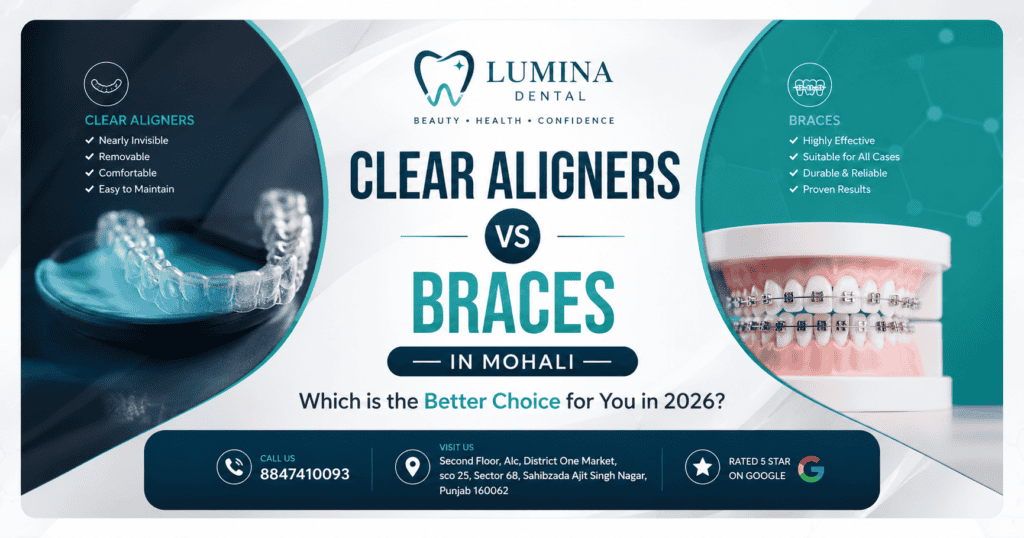
Clear Aligners vs Braces in Mohali — Which is the Better Choice for You in 2026? You have made the decision. You want straighter teeth. Now comes the question that brings most patients to our clinic in Sector 68 Mohali — clear aligners or braces? Which one is actually better? Which one is right for your specific situation? This is not a simple answer — and anyone who tells you one is always better than the other is not giving you the full picture. The right choice depends on your teeth, your lifestyle, your age, your budget and how quickly you want results. At Lumina Dental, Mohali, we offer both clear aligners and traditional braces — so we have no reason to push you toward one or the other. What we have is the clinical experience to help you make the right decision for your specific case. This blog gives you the complete honest comparison — what each option involves, how they compare on every factor that matters and which patients tend to benefit most from each. What Are Clear Aligners? Clear aligners are a modern orthodontic treatment that uses a series of clear, removable trays to gradually shift teeth into the desired position. These aligners are custom-made using advanced 3D imaging technology, ensuring precision and comfort throughout the treatment process. At Lumina Dental, Mohali, we offer clear aligner treatment using clinically proven aligner systems — custom-made from medical-grade transparent material for your specific teeth. Each set of clear aligners is worn for about 1-2 weeks before switching to the next set — each tray moving your teeth slightly closer to the final position. The process is gradual, controlled and completely reversible at any stage. The key advantages that make clear aligners the most popular orthodontic choice among adults and working professionals in Mohali and Chandigarh: What Are Traditional Braces? Traditional braces use metal brackets bonded to the teeth connected by a wire that is periodically tightened to apply progressive force on the teeth. Modern braces have improved significantly from earlier generations — brackets are smaller, wires are more efficient and ceramic tooth-coloured brackets are available as a less visible alternative to metal. Braces remain highly effective — particularly for complex cases involving significant rotation, vertical movement or bite correction that may be harder to achieve with aligners alone. The main considerations with braces: Clear Aligners vs Braces — The Complete Comparison 1. Appearance Clear AlignersClear aligners are virtually invisible, made from medical-grade BPA-free plastic — when worn correctly nobody notices them during normal conversation, photographs or professional meetings. This is the primary reason working professionals, college students and adults in Mohali choose aligners overwhelmingly over braces. BracesMetal braces are clearly visible. Ceramic or tooth-coloured brackets are significantly less noticeable but still visible on close inspection. For patients whose priority is discretion — particularly professionals and adults — braces are a significant compromise on appearance. Winner: Clear Aligners — completely discreet treatment. 2. Comfort Clear AlignersSmooth plastic with no sharp edges. Initial mild pressure when switching to a new tray is normal and settles within 1-2 days. No emergency appointments for broken brackets or poking wires. Most patients describe clear aligner treatment as genuinely comfortable. BracesThe brackets and wires can cause mouth ulcers on the inner cheeks and lips — particularly in the first few weeks and after tightening appointments. Wires can occasionally poke if they shift, requiring an emergency clinic visit. Winner: Clear Aligners — significantly more comfortable day to day. 3. Effectiveness — What Can Each Treat? This is where the honest answer matters most. Clear AlignersInvisalign treats a wide range of issues — crowding, spacing, overbite, underbite, crossbite and open bite — in adults and older teenagers. For mild to moderate alignment issues — which covers the vast majority of patients seeking orthodontic treatment in Mohali — clear aligners deliver excellent results comparable to braces. BracesBraces have a slight clinical advantage for very complex cases — significant tooth rotation, large vertical movements and severe bite correction. For these specific situations our specialist may recommend braces as the more predictable option. Winner: Depends on case complexity — for most patients, aligners are equally effective. For very complex cases, braces may be recommended. Our specialist assesses this at your free consultation. 4. Treatment Duration Clear AlignersTreatment time varies by case but most patients complete clear aligner treatment in 6 to 18 months. Some mild cases can be completed in as little as 4-6 months. BracesTraditional braces typically take 18-36 months for comprehensive treatment. Mild cases can be faster but braces generally take longer than equivalent aligner treatment. Winner: Clear Aligners — typically faster for most cases. 5. Oral Hygiene During Treatment Clear AlignersClear aligners are removable — you can eat your favourite food without worrying about brackets. Remove aligners, brush and floss normally, clean the aligners and put them back in. Oral hygiene during aligner treatment is essentially the same as normal. BracesCleaning around brackets and under wires requires special tools — interdental brushes, floss threaders and water flossers. Plaque builds up more easily around brackets, increasing the risk of white spot lesions on enamel if cleaning is insufficient. This requires significantly more effort and discipline. Winner: Clear Aligners — normal oral hygiene maintained throughout treatment. 6. Diet Clear AlignersNo dietary restrictions. Remove aligners before eating and drinking anything other than water — put them back in after brushing. You can eat anything you want throughout treatment. BracesHard foods (nuts, raw carrots, hard candy, crusty bread), sticky foods (toffee, chewing gum, caramel) and chewy foods must be avoided throughout treatment to protect brackets and wires. Dietary restriction for 18-36 months is a significant lifestyle adjustment. Winner: Clear Aligners — complete dietary freedom. 7. Cost in Mohali Clear AlignersInvisalign and premium clear aligners sit at the higher end of the pricing spectrum. At Lumina Dental, Mohali, clear aligners start from ₹45,000 onwards depending on the complexity of your case and the aligner system used. Easy no cost EMI options
Dental Implants vs Dental Bridge in Mohali: Which Is Better for a Missing Tooth?
Dental Implants vs Dental Bridge in Mohali: Which Is Better for a Missing Tooth? Losing a tooth can affect much more than your smile. A missing tooth can make chewing difficult, affect your speech, allow neighboring teeth to shift, and contribute to changes in the jawbone over time. Fortunately, modern dentistry offers several ways to replace a missing tooth. Two of the most common options are dental implants and dental bridges. But which one is better? If you are searching for dental implants vs dental bridge in Mohali, this guide will help you understand the differences between the two treatments, their advantages and limitations, expected longevity, maintenance requirements, and which option may be more suitable for your smile. At Lumina Dental, Mohali, we evaluate your teeth, gums, jawbone, bite, and overall oral health before recommending a tooth replacement option that suits your individual needs. Dental Implants vs Dental Bridge: Quick Comparison Before going into detail, here is a simple comparison: Feature Dental Implant Dental Bridge Replaces tooth root Yes No Uses neighbouring teeth for support No Usually yes Helps preserve jawbone Yes No Treatment involves surgery Yes No implant surgery Feels similar to a natural tooth Very similar Natural-looking and functional Can replace a single missing tooth Yes Yes Maintenance Similar to natural teeth with proper care Requires careful cleaning around bridge Long-term solution Yes Yes, but may require replacement Suitable for everyone Not always Often suitable depending on supporting teeth What Is a Dental Implant? A dental implant is a replacement for both the missing tooth and its root. A small titanium implant is placed into the jawbone. After the implant integrates with the bone, a custom-made dental crown is attached to restore the visible part of the tooth. This allows the implant to function as an independent tooth replacement. The Indian Dental Association describes dental implants as titanium posts placed into the jaw to support replacement teeth, while the American Academy of Periodontology notes that a single implant can replace both the missing tooth and its root. Main advantages of dental implants At Lumina Dental Mohali, implant treatment begins with detailed assessment and 3D imaging to plan implant placement according to the patient’s anatomy and needs. For more info: https://luminadental.in/dental-implants-in-mohali/ What Is a Dental Bridge? A dental bridge replaces a missing tooth by placing an artificial tooth, called a pontic, in the gap. A traditional dental bridge is generally supported by crowns placed over the neighbouring teeth. In simple terms, the neighboring teeth act as anchors while the artificial tooth fills the missing space. According to the Indian Dental Association, dental bridges can replace one or more missing teeth and traditional fixed bridges are commonly supported by neighbouring teeth. Main advantages of dental bridges However, traditional bridges generally require preparation of the teeth supporting the bridge. For more info: https://luminadental.in/dental-crowns-bridges/ Dental Implants vs Dental Bridge: 7 Important Differences 1. How They Replace the Missing Tooth The biggest difference is how the treatment replaces the tooth. A dental implant replaces the tooth root as well as the visible tooth. A traditional dental bridge replaces the visible portion of the missing tooth but is supported by neighboring teeth. This makes implants more similar to having an independent natural tooth. 2. Effect on Neighbouring Teeth This is one of the most important factors when comparing dental implants vs dental bridges. A single dental implant does not normally require neighbouring healthy teeth to be prepared for crowns. A traditional bridge, on the other hand, usually relies on adjacent teeth for support, which means those teeth need to be prepared. If the teeth next to your missing tooth are healthy and strong, preserving them may be an important consideration when discussing your options with your dentist. 3. Effect on Jawbone After a tooth is lost, the bone that previously supported its root can gradually resorb. Because a dental implant is placed into the jawbone and functions as an artificial tooth root, it can help maintain the bone around the implant. A conventional bridge does not replace the missing root. The American Academy of Periodontology specifically identifies preservation of the bone around the missing tooth as an advantage of a single dental implant over a tooth-supported bridge. 4. Treatment Time A dental bridge can often be completed relatively quickly once the supporting teeth are prepared. Dental implant treatment generally takes longer because the implant needs time to integrate with the jawbone before the final restoration is placed. The exact timeline varies depending on: Therefore, faster treatment does not necessarily mean better treatment. The goal should be choosing the option that provides the right balance of health, function, aesthetics, and long-term stability. 5. Appearance and Comfort Both modern dental implants and bridges can provide natural-looking results. However, implants have an important advantage: they are independently supported rather than relying on neighboring teeth. A well-planned implant with a high-quality crown can closely replicate the appearance and function of a natural tooth. The final result also depends on factors such as the position of the tooth, gum condition, crown design, bite, and the skill of the dental team. 6. Maintenance Dental implants should be cared for much like natural teeth, with regular brushing, flossing or interdental cleaning, and professional dental checkups. Dental bridges also require regular brushing and careful cleaning around and underneath the bridge. Regardless of whether you choose an implant or bridge, maintaining excellent oral hygiene is essential for protecting your remaining teeth and gums. 7. Long-Term Considerations When comparing a dental implant vs dental bridge, don’t look only at the initial treatment. Consider: A treatment that appears cheaper initially may not necessarily be the most economical option over the long term. Dental Implant vs Dental Bridge: Which One Is Better? There is no single answer that applies to every patient. However, a dental implant may be preferable when you have a single missing tooth, adequate bone and healthy gums, and want an independent long-term tooth replacement without preparing healthy neighbouring teeth. A dental
How Long Do Dental Implants Last? — The Complete Honest Answer
How Long Do Dental Implants Last? — The Complete Honest Answer If you are considering dental implants in Mohali — this is probably one of the first questions in your mind. You are about to make a significant investment in your health and your smile. You want to know whether that investment will stand the test of time. Whether dental implants are truly permanent. Whether you will be doing this again in five years. These are completely reasonable questions — and they deserve completely honest answers. At Lumina Dental, Sector 68 Mohali, we believe in giving patients the full picture before they commit to any treatment. So here it is — everything you need to know about how long dental implants actually last, what affects their lifespan and what you can do to maximise the return on your investment. The Short Answer — How Long Do Dental Implants Last? With proper care and maintenance, dental implants can last a lifetime. That is not a marketing claim. It is the clinical reality backed by decades of research and long-term patient follow-up studies. The titanium implant fixture that is placed into your jawbone integrates permanently with the bone through a process called osseointegration — forming a biological bond that, in successful cases, is essentially permanent. Many patients worldwide have had the same dental implants for 30-40 years and counting — with no sign of failure. However — and this is important — dental implants have two components, each with a different lifespan: The implant fixture — the titanium screw in your jawbone — is designed to last a lifetime with proper care. The crown — the visible tooth on top — typically lasts 15-25 years before needing replacement, depending on how well it is maintained and the forces it is subjected to. Understanding this distinction is important because it helps you plan realistically and take the right steps to protect your investment long-term. What the Research Says About Dental Implant Lifespan Dental implants have the most extensively studied long-term track record of any tooth replacement option available. Research consistently shows dental implant survival rates of over 95% at 10 years — meaning the vast majority of implants placed are still functioning perfectly a decade later. Studies following patients for 20+ years show similarly impressive results when patients maintain good oral hygiene and attend regular checkups. At Lumina Dental, Mohali, our specialist doctors follow internationally established protocols for implant placement — including CBCT 3D planning, precise positioning and premium international implant brands — all of which contribute to the long-term success rate of every implant we place. Why Do Some Dental Implants Fail Earlier Than Expected? Dental implants are highly successful — but they are not infallible. Understanding what causes implant failure helps you avoid it. 1. Poor oral hygieneThis is the most common cause of long-term implant failure. A condition called peri-implantitis — essentially gum disease around the implant — develops when bacteria accumulate at the gum line. Left untreated, peri-implantitis destroys the bone supporting the implant, eventually causing it to fail. Regular brushing, flossing and professional cleaning prevent this entirely. 2. SmokingSmoking is one of the most significant risk factors for implant failure — both in the short term during healing and in the long term. Nicotine restricts blood flow to the gums and bone, impairing healing and increasing susceptibility to infection around the implant. Patients who smoke face significantly higher implant failure rates than non-smokers. 3. Uncontrolled medical conditionsCertain systemic conditions — particularly poorly controlled diabetes — affect how well the body heals and integrates the implant. With proper medical management these conditions can be accommodated, but uncontrolled blood sugar significantly increases failure risk. 4. Poor quality implant brandsNot all dental implants are created equal. Budget implant brands with lower quality titanium, inferior surface treatment and less precise manufacturing have lower long-term success rates than premium international brands. At Lumina Dental, Mohali, we use only internationally certified premium titanium implant fixtures — the same brands used in top clinics worldwide. 5. Overloading the implantHabits like grinding teeth at night (bruxism), chewing extremely hard foods habitually or placing excessive force on the implant crown can stress the implant and accelerate wear on the crown. A night guard is recommended for patients who grind their teeth. 6. Insufficient bone at placementAn implant placed in insufficient bone — without appropriate bone grafting where needed — has a higher risk of failure over time. This is why thorough CBCT 3D assessment before placement is critical. The Implant Crown — When Does It Need Replacing? While the titanium implant itself is designed to last a lifetime, the crown — the visible portion that resembles a natural tooth — has a finite lifespan. Most dental implant crowns last between 15-25 years before needing replacement. The main factors that affect crown longevity are: Material of the crownZirconia crowns are the most durable and natural-looking option — highly resistant to chipping, staining and wear. They typically outlast porcelain-fused-to-metal crowns in the long term. At Lumina Dental, Mohali, our specialist discusses crown options at your consultation and helps you choose the best material for your specific case and bite. Location in the mouthBack teeth (molars) are subjected to significantly more biting force than front teeth. Molar implant crowns generally experience more wear than anterior crowns and may need replacement sooner. Oral hygiene habitsGood oral hygiene not only protects the implant itself but also extends the life of the crown — keeping the gum line healthy and the crown seated correctly. Teeth grinding (bruxism)Patients who grind their teeth at night can significantly shorten the lifespan of their implant crown. A custom night guard from Lumina Dental, Mohali protects both the crown and the implant from grinding forces. DietHabitually chewing ice, very hard nuts, hard candy or biting on non-food objects puts excessive stress on the crown and can cause chipping or cracking — particularly with porcelain crowns. The good news is that when a crown does eventually need replacing
What Happens If You Never Replace a Missing Tooth?
What Happens If You Never Replace a Missing Tooth? Losing a tooth may not seem like a major problem—especially if it’s hidden at the back of your mouth. Many people delay treatment because they don’t experience immediate pain or discomfort. However, leaving a missing tooth untreated can lead to serious oral health issues over time. If you’re wondering what happens if you never replace a missing tooth, the answer is simple: your oral health, appearance, and even overall well-being can gradually be affected. In this blog, we’ll explain the long-term consequences of tooth loss and why replacing a missing tooth early is the best decision for your smile. Why Replacing a Missing Tooth Matters Every tooth in your mouth plays an important role. Your teeth work together to help you chew, speak clearly, maintain facial structure, and keep neighbouring teeth in their correct positions. When one tooth is lost, it creates a gap that affects much more than your smile. Over time, your mouth begins to adapt to that empty space—and unfortunately, those changes are usually harmful. 1. Nearby Teeth Begin to Shift One of the first missing tooth consequences is that the surrounding teeth start moving toward the empty space. When teeth shift, it can lead to: Eventually, you may require orthodontic treatment in addition to replacing the missing tooth. 2. Jawbone Starts Shrinking Your jawbone stays healthy because tooth roots stimulate the bone every time you chew. Once a tooth is missing, that stimulation stops. As a result: This is one of the biggest reasons dentists recommend replacing a missing tooth as soon as possible. 3. Chewing Becomes Less Efficient A missing tooth changes how you chew food. Many patients unknowingly begin chewing only on one side of the mouth, which can lead to: Proper chewing is essential for good oral and overall health. 4. Your Bite Can Change Even losing a single tooth can affect your bite. As surrounding teeth shift and opposing teeth begin to move, your bite may become uneven. This can result in: Correcting bite problems later often requires more extensive treatment. 5. Increased Risk of Gum Disease Gaps created by missing teeth can trap food particles more easily. This creates the perfect environment for bacteria to grow, increasing your chances of: Maintaining oral hygiene also becomes more difficult when teeth have shifted. 6. Facial Appearance Can Change Many people don’t realize that teeth help support facial muscles. After tooth loss, jawbone shrinkage can make the face appear: This process happens gradually but becomes more noticeable over the years. Replacing missing teeth helps preserve your natural facial structure. 7. Speech May Be Affected Certain teeth play an important role in pronouncing words correctly. Depending on which tooth is missing, you may experience: Replacing the missing tooth often restores normal speech. 8. More Stress on Remaining Teeth When one tooth is missing, the remaining teeth have to do extra work. This increased pressure can lead to: Protecting your remaining natural teeth should always be a priority. 9. Future Treatment Becomes More Expensive Many people postpone treatment hoping to save money. Ironically, delaying treatment often increases the overall cost because additional procedures may become necessary, including: Replacing a missing tooth early is usually the most cost-effective option. Best Options to Replace a Missing Tooth Fortunately, modern dentistry offers several effective missing tooth treatment options. Dental Implants Dental implants are considered the gold standard for replacing missing teeth because they: For more info: https://luminadental.in/dental-implants-in-mohali/ Dental Bridge A dental bridge fills the gap using adjacent teeth for support. It is suitable for many patients, although it requires preparation of nearby healthy teeth. Dentures Partial dentures are another option, especially when multiple teeth are missing. Your dentist can recommend the most suitable treatment based on your oral health and budget. When Should You Replace a Missing Tooth? Ideally, you should replace a missing tooth as soon as your dentist confirms that the area has healed properly. Early treatment helps: The sooner you act, the more treatment options you’ll have. Why Choose Lumina Dental for Missing Teeth Treatment? At Lumina Dental, Mohali, we understand that every smile is unique. Our experienced dental team provides personalized treatment plans using advanced technology to restore both function and aesthetics. Whether you need a dental implant, bridge, or another tooth replacement solution, we’ll guide you through every step of your treatment with comfort and care. If you’ve lost a tooth recently—or even years ago—it’s never too late to explore your options. Frequently Asked Questions (FAQs) Is it okay to leave one missing tooth untreated? Although you may not notice immediate problems, leaving even one missing tooth untreated can cause neighbouring teeth to shift, jawbone loss, bite changes, and chewing difficulties over time. How long can I wait before replacing a missing tooth? The earlier you replace a missing tooth, the better. Delaying treatment increases the risk of bone loss and may require additional procedures later. What is the best treatment for a missing tooth? Dental implants are generally considered the most effective long-term solution because they replace both the tooth and its root while preserving jawbone health. Can a missing tooth change my face? Yes. Tooth loss can lead to jawbone shrinkage, which may eventually cause the face to appear sunken or older. Is replacing a missing tooth painful? Modern dental treatments are performed using advanced techniques and local anesthesia, making the procedure comfortable for most patients. Final Thoughts Ignoring a missing tooth may seem harmless at first, but the effects become more serious with time. From shifting teeth and bone loss to chewing problems and changes in facial appearance, the consequences of untreated tooth loss can impact both your oral health and confidence. If you’re wondering what happens if you never replace a missing tooth, the best answer is: the sooner you replace it, the better your long-term oral health will be. At Lumina Dental, Mohali, we’re committed to helping you restore your smile with safe, modern, and personalized tooth replacement solutions.
All-on-4 Dental Implants in Mohali — Complete Guide for 2026
All-on-4 Dental Implants in Mohali — Complete Guide for 2026 Losing most or all of your teeth is one of the most significant things that can happen to your quality of life. It affects how you eat. How you speak. How you smile in photographs. Whether you feel comfortable laughing openly in a room full of people. These are not small things — they are fundamental to how you experience daily life and how confident you feel in the world. For decades, the only solution for people who had lost most or all of their teeth was complete dentures. And while dentures provide some functional replacement, they come with well-known limitations — slipping during eating, restricted diet, ongoing bone loss beneath them and the daily inconvenience of removal and soaking. All-on-4 dental implants changed that. At Lumina Dental, Sector 68 Mohali, we offer All-on-4 dental implant treatment — giving patients who have lost most or all of their teeth a permanent, fixed, natural-looking full set of teeth supported by just four implants. No dentures. No removable parts. Just permanent teeth you care for exactly like natural ones. This complete guide explains everything you need to know — what All-on-4 is, how it works, who is a good candidate, what the procedure involves, how much it costs in Mohali and why patients across Mohali and Chandigarh choose Lumina Dental for this treatment. What Are All-on-4 Dental Implants? All-on-4 is a full arch dental implant solution — meaning it replaces all the teeth in your upper jaw, lower jaw or both — using just four strategically placed implants per arch. The name describes exactly what it is: all of your teeth on four implants. Traditional full mouth implant restoration required one implant per missing tooth — which for a full arch meant 10-14 implants, significant cost and extensive surgery. All-on-4 changed the equation entirely by demonstrating that four carefully angled implants can provide sufficient support for a complete fixed arch of teeth. The four implants are placed at specific angles — two at the front of the jaw positioned vertically and two at the back positioned at an angle of up to 45 degrees. This angled placement achieves two important things: it maximises contact with available bone and it distributes the load of biting and chewing more efficiently across the arch. A fixed bridge — containing a complete set of replacement teeth — is then attached to these four implants. The result is a permanent, stable, natural-looking full set of teeth that does not come out and does not move. For more info: https://luminadental.in/dental-implants-in-mohali/ Who is All-on-4 For? All-on-4 dental implants in Mohali at Lumina Dental are suitable for: Patients who have lost most or all teeth in one or both archesWhether tooth loss happened gradually over years or more suddenly due to injury, decay or gum disease — if you are missing most or all teeth in an arch, All-on-4 may be the most appropriate and cost-effective solution. Patients who are unhappy with denturesIf you currently wear dentures and are frustrated with the limitations — slipping, restricted diet, difficulty speaking, daily removal — All-on-4 offers a permanent fixed alternative that eliminates all of these issues. Patients who cannot afford individual implants for every toothAll-on-4 provides a full arch of permanent fixed teeth at a significantly lower cost than placing individual implants for each missing tooth — making it an accessible solution for patients who need comprehensive tooth replacement. Patients with some degree of bone lossOne of the advantages of All-on-4 is that the angled posterior implants can often utilise available bone that would be insufficient for traditional implant placement. This means many patients who have experienced bone loss — and who might be told they need bone grafting for conventional implants — can still receive All-on-4 without grafting. Patients who want same-day teethIn suitable cases, a temporary fixed bridge can be attached to the implants on the same day as surgery — giving patients functioning teeth immediately after their procedure. Permanent teeth are fitted after the healing period. All-on-4 vs Traditional Full Mouth Implants — What is the Difference? Patients considering All-on-4 in Mohali often ask how it compares to having individual implants for each tooth. Here is an honest comparison: Factor All-on-4 Individual Implants Per Tooth Number of implants 4 per arch 10-14 per arch Surgery complexity Single procedure Multiple staged procedures Cost Significantly lower Significantly higher Bone requirement Less bone needed More bone needed Need for bone grafting Often avoided More frequently required Healing time 3-6 months for permanent bridge 6-12 months or more Result Full arch fixed teeth Full arch fixed teeth Maintenance Normal brushing and flossing Normal brushing and flossing Longevity Long-lasting with proper care Long-lasting with proper care For patients needing full arch restoration, All-on-4 delivers comparable functional and aesthetic outcomes at significantly lower cost and with less surgical intervention. All-on-4 vs Dentures — Why Patients Choose Implants If you currently wear dentures or are considering them as an alternative to All-on-4, here is what you need to understand about the long-term difference: Dentures cause bone loss. All-on-4 prevents it.Every day that dentures sit on your gums without stimulating the jawbone beneath, that bone is gradually resorbing. Over years this leads to a characteristic sunken facial appearance, increasingly poor denture fit and — eventually — so little bone that even dentures become difficult to wear. All-on-4 implants stimulate the jawbone exactly like natural teeth roots, preserving bone and maintaining your facial structure. Dentures move. All-on-4 does not.The All-on-4 bridge is fixed to the implants — it does not move, shift, click or slip. You eat, speak and smile with complete confidence without any awareness of your teeth. Dentures restrict diet. All-on-4 does not.With All-on-4, you can eat virtually anything — hard foods, crunchy foods, tough meat, raw vegetables. The restricted diet that characterises denture wearing ends completely. Dentures require daily removal and maintenance. All-on-4 does not.Your All-on-4 bridge is cared for exactly like natural teeth
Can Diabetic Patients Get Dental Implants? — The Complete Honest Answer
Can Diabetic Patients Get Dental Implants? — The Complete Honest Answer This is one of the most common questions we receive at Lumina Dental, Sector 68 Mohali — and it comes with a lot of anxiety attached to it. A patient comes in wanting dental implants. They have been living with a missing tooth for months or years. They are ready to finally do something about it. And then they hesitate — because they have diabetes, and someone told them they cannot get implants. That someone was wrong. The complete, honest answer is this: yes, diabetic patients can get dental implants — and at Lumina Dental, Mohali, we have successfully placed implants in many patients managing diabetes. However there are important things to understand before proceeding. This blog explains everything — how diabetes affects dental implants, what makes a diabetic patient a good candidate, how we manage the process at our Mohali clinic and what you can do right now to improve your chances of a successful outcome. Why Do People Think Diabetics Cannot Get Dental Implants? The concern comes from a real and legitimate place. Diabetes affects the body’s ability to heal, manage infection and regulate blood flow. These are all factors that matter in implant surgery and healing. In the past — when implant technology was less advanced and screening less thorough — diabetic patients did face higher complication rates. This led to a blanket assumption that diabetes and dental implants do not mix. Modern implant dentistry tells a very different story. The best dental keywords combine high commercial intent with local relevance — procedure-specific local terms like dental implants in a specific city consistently outperform generic terms. And searches like “can diabetics get dental implants” reflect exactly this — patients in Mohali and Chandigarh who have diabetes and are actively looking for an honest answer before booking a consultation. The honest answer is that well-controlled diabetes is not a barrier to dental implants. Uncontrolled diabetes is a different matter — and we will explain the distinction clearly. How Diabetes Affects Dental Health Before understanding implants specifically, it helps to understand what diabetes does to your teeth and gums in general. Increased risk of gum diseasePeople with diabetes are significantly more susceptible to periodontal (gum) disease. High blood sugar creates an environment where bacteria thrive — leading to inflammation, infection and breakdown of the gum tissue and bone that support your teeth. This is actually one of the most common reasons diabetic patients lose teeth in the first place. Slower healingDiabetes affects circulation and immune response — both of which are critical for wound healing after any surgical procedure including dental implant placement. Higher infection riskCompromised immune function means diabetic patients are more vulnerable to post-surgical infection if blood sugar is not well managed at the time of treatment. Dry mouthMany diabetic patients experience dry mouth — which reduces the natural protective effects of saliva and increases the risk of decay and gum problems. The key point: all of these factors are manageable. With proper preparation, monitoring and aftercare — diabetic patients can and do achieve excellent dental implant outcomes. What the Research Says — Can Diabetics Get Dental Implants? Yes — and research consistently supports this. Studies show that patients with well-controlled diabetes have dental implant success rates comparable to non-diabetic patients. The critical variable is not whether you have diabetes — it is how well your blood sugar is controlled at the time of treatment and during healing. Patients with HbA1c levels below 7-8% — indicating good to moderate blood sugar control — are generally considered good candidates for dental implants with appropriate precautions. Patients with poorly controlled diabetes — HbA1c significantly above 8% — face higher risks of complications including slower healing, infection and implant failure. For these patients, we recommend working with their physician to improve blood sugar control before proceeding. At Lumina Dental, Mohali, our specialist assesses every diabetic patient individually — reviewing their current HbA1c, medication, overall health and oral condition — before recommending implant treatment. This thorough assessment is what makes the difference between a successful outcome and a complication. What Makes a Diabetic Patient a Good Candidate for Dental Implants? These are the factors our implant specialist assesses at Lumina Dental, Sector 68 Mohali, when evaluating a diabetic patient for implants: 1. Blood sugar control (HbA1c)This is the most important factor. Well-controlled diabetes — generally HbA1c below 7.5-8% — significantly improves implant success rates. We may ask you to share your recent HbA1c results at your consultation. 2. Duration of diabetesLong-standing diabetes with complications such as kidney disease, peripheral neuropathy or cardiovascular issues requires more careful evaluation than recently diagnosed or well-managed diabetes. 3. Current medicationsSome diabetes medications can affect healing or interact with anaesthesia. Our specialist reviews your medication list at consultation to plan accordingly. 4. Gum healthActive gum disease must be treated before implant placement — this applies to all patients but is especially important for diabetic patients. Healthy gums are a prerequisite for successful implants. 5. Jawbone densityDiabetes can contribute to bone loss over time. We use CBCT 3D scanning to assess your jawbone density accurately — and if bone grafting is needed, we discuss this clearly before proceeding. 6. Smoking statusSmoking significantly impairs healing in all patients — but the combined effect of smoking and diabetes on implant success is particularly significant. We strongly recommend quitting before implant treatment. How We Manage Dental Implants for Diabetic Patients at Lumina Dental, Mohali At Lumina Dental, Sector 68 Mohali, we follow a structured protocol for diabetic patients considering dental implants — designed to maximise success and minimise risk. Step 1 — Thorough assessment at free consultationWe review your complete medical history, current medications, recent HbA1c levels and perform a full oral examination including CBCT 3D scan. This gives us a complete picture before any recommendation is made. Step 2 — Gum disease treatment if neededIf any gum disease is present, we treat this completely before proceeding with
Dental Implant Cost in Mohali (2026): Complete Price Guide, Factors & EMI Options
Dental Implant Cost in Mohali (2026): Complete Price Guide, Factors & EMI Options If you’ve lost a tooth and are exploring your replacement options, one of the first questions that probably comes to mind is: “How much does a dental implant cost?” It’s one of the most searched questions by patients considering permanent tooth replacement—and for good reason. Dental implants are widely regarded as the most advanced, natural-looking, and long-lasting solution for replacing missing teeth. However, many people assume that dental implants are unaffordable without actually understanding what influences the cost. The truth is that dental implant cost depends on several factors, including the quality of the implant, the condition of your jawbone, the number of teeth being replaced, and the expertise of the dentist performing the procedure. At Lumina Dental Clinic, Mohali, we believe every patient deserves transparent pricing and honest guidance. That’s why we offer dental implants starting from just ₹19,999, along with No Cost EMI options starting from only ₹2,999 per month, making high-quality dental care more accessible than ever. Whether you’re looking for a single tooth implant, multiple dental implants, or a complete smile restoration, this guide will help you understand everything about dental implant cost in Mohali, what affects the pricing, and why choosing the right dental clinic is more important than simply choosing the lowest price. What Is a Dental Implant? A dental implant is a small, biocompatible titanium post that is surgically placed into your jawbone to replace the root of a missing tooth. Once the implant integrates naturally with the bone, it provides a strong and stable foundation for a dental crown, bridge, or even a full-mouth restoration. Unlike removable dentures or traditional bridges, dental implants feel, function, and look remarkably similar to natural teeth. With proper care and regular dental check-ups, dental implants can last for many years, making them one of the most reliable long-term investments in your oral health. For more info: https://luminadental.in/dental-implants-in-mohali/ What Is the Dental Implant Cost in Mohali? One of the biggest concerns patients have before starting treatment is the overall investment involved. At Lumina Dental Clinic, Mohali, dental implants start from just ₹19,999, depending on your individual treatment requirements. To make treatment even more affordable, we also offer: ✅ No Cost EMI starting from just ₹2,999 per month This means you don’t have to postpone replacing your missing teeth due to financial concerns. Our team will evaluate your oral health, discuss the most suitable treatment options, and recommend a personalized plan based on your needs. Please Note: Every patient’s case is unique. The final treatment cost depends on your oral condition, the number of implants required, and whether additional procedures are necessary before implant placement. Why Does Dental Implant Cost Vary Between Clinics in Mohali? If you’ve been comparing dental implant costs in Mohali, you’ve probably noticed that prices can vary significantly from one clinic to another. While it’s natural to compare prices, it’s equally important to understand what you’re paying for. A dental implant is a long-term investment in your oral health, so choosing a clinic based only on the lowest price may not always be the best decision. What Can Affect the Cost of Dental Implants? Several factors influence the overall cost, including: Is the Cheapest Dental Implant Always the Best Choice? Very low-priced dental implant treatments may sometimes involve compromises such as lower-quality implant systems, limited diagnostic planning, or additional charges that are only discussed later. Instead of comparing price alone, patients should also consider the clinic’s experience, technology, treatment planning, and long-term success rates. Why Patients Choose Lumina Dental Clinic, Mohali At Lumina Dental Clinic, Mohali, we focus on providing high-quality dental implant treatment with transparent pricing. Our patients benefit from: Our goal is to provide the right balance of affordability, quality, and long-term success, so every patient can make an informed decision with confidence. Why Do Dental Implant Costs Vary? Many patients wonder why dental implant prices differ from one clinic to another. The answer is simple—not all dental implants or treatment plans are the same. Several important factors influence the overall cost. 1. Number of Missing Teeth Replacing a single missing tooth naturally costs less than replacing multiple teeth or performing a full-mouth rehabilitation. The treatment plan is customized according to the number of implants required. 2. Quality of the Dental Implant System Dental implants are manufactured by different international companies, each with varying levels of research, technology, precision, and long-term clinical success. Premium implant systems often provide better durability, excellent integration with the jawbone, and predictable long-term results. Choosing high-quality implants is an investment in the longevity of your smile. 3. Bone Quality and Bone Availability Dental implants require sufficient jawbone support. If you’ve been missing a tooth for several years, the surrounding bone may have naturally shrunk over time. In some cases, additional procedures such as bone grafting may be recommended to create a strong foundation before implant placement. 4. Experience of the Implant Dentist Dental implant placement is a precision-driven procedure. An experienced implant dentist carefully plans the position, angle, and depth of every implant to ensure optimal function, aesthetics, and long-term success. While lower-cost options may seem attractive initially, choosing a skilled and experienced dentist significantly reduces the risk of complications and future corrective treatments. 5. Technology Used During Treatment Modern dental clinics often use advanced technologies such as: These technologies improve diagnosis, increase treatment accuracy, and enhance patient safety. Are Dental Implants Worth the Cost? One of the most common questions patients ask is whether dental implants justify their cost. The answer is yes, especially when compared to temporary tooth replacement options. Unlike removable dentures or traditional bridges, dental implants: Rather than viewing dental implants as an expense, many patients consider them a long-term investment in their health, confidence, and quality of life. Why Replacing a Missing Tooth Early Can Save You Money Many people delay treatment after losing a tooth, thinking it isn’t urgent. Unfortunately, delaying replacement often leads to additional oral
Dental Implants vs Dentures in Mohali — Which is the Better Choice for You?
Dental Implants vs Dentures in Mohali — Which is the Better Choice for You? You have a missing tooth — or several missing teeth — and you need to do something about it. Your dentist has mentioned two options. Dental implants. Dentures. And now you are sitting at home trying to figure out which one is actually right for you. This is one of the most common questions we receive at Lumina Dental, Sector 68 Mohali — and it deserves a completely honest answer. Not a sales pitch. Not a one-size-fits-all recommendation. A genuine comparison that helps you make the right decision for your specific situation. This blog covers everything — what dental implants and dentures actually are, how they compare on comfort, appearance, cost, longevity and quality of life, and which option our specialist doctors at Lumina Dental, Mohali typically recommend and why. What Are Dental Implants? A dental implant is a small titanium screw that is surgically placed into your jawbone — acting as an artificial root for your missing tooth. Once the implant integrates with the bone over a period of weeks, a custom-made crown is attached on top. The result is a permanent, fixed tooth that: Dental implants in Mohali at Lumina Dental start from ₹19,999 per tooth with no cost EMI options available. For more info: https://luminadental.in/dental-implants-in-mohali/ What Are Dentures? Dentures are removable prosthetic teeth — a set of artificial teeth attached to a gum-coloured plastic base that sits over your gums. Complete dentures replace all teeth in the upper or lower jaw — or both. Partial dentures replace several missing teeth when some natural teeth remain. They clip onto remaining teeth for support. Dentures are removed at night for cleaning and soaked in a cleaning solution. They are held in place during the day by suction, adhesive or clasps on remaining teeth. Dental Implants vs Dentures — The Complete Comparison 1. Appearance Dental ImplantsDental implants are indistinguishable from natural teeth. Each crown is custom-made and colour-matched to your surrounding teeth. Nobody — not even your dentist — will be able to tell the difference between your implant and your natural tooth. DenturesModern dentures look significantly better than older generations. However they can still appear artificial — particularly when smiling widely or laughing. The plastic base covering the gums is visible and does not replicate the natural appearance of gum tissue. Winner: Dental Implants — consistently more natural-looking in every clinical comparison. 2. Comfort and Feel Dental ImplantsBecause the implant is fixed in the jawbone, it feels completely natural. There is no awareness of the implant during eating, speaking or any daily activity. Patients consistently report forgetting they have an implant within weeks of placement. DenturesDentures sit on top of the gums and do not anchor into the jawbone. This means they can move, shift, click or slip during eating and speaking — particularly as the jawbone changes shape over time. Many denture wearers experience sore spots on the gums from friction, and significant discomfort when eating harder foods. Winner: Dental Implants — fixed position, zero movement, completely natural feel. 3. Eating and Chewing Dental ImplantsWith dental implants you can eat absolutely anything — hard foods, crunchy foods, sticky foods, raw vegetables, meat — exactly as you would with natural teeth. Chewing force with implants is approximately 80-90% of natural teeth, compared to 20-25% with dentures. DenturesDenture wearers must avoid many foods — hard nuts, tough meat, sticky sweets, raw carrots, crusty bread and apples all present challenges. The restricted diet is one of the most significant quality of life impacts reported by denture wearers. Winner: Dental Implants — no dietary restrictions, full chewing function. 4. Effect on Jawbone This is perhaps the most clinically important difference — and the one most patients are unaware of. Dental ImplantsThe titanium implant mimics a natural tooth root — stimulating the jawbone every time you bite. This stimulation is what keeps the jawbone healthy and prevents bone loss. With dental implants your jawbone remains strong and your facial structure is preserved. DenturesDentures sit on the gums and provide no stimulation to the jawbone beneath. Without this stimulation the jawbone begins to resorb — shrink — over time. This is why long-term denture wearers develop a sunken facial appearance. The bone loss also changes the shape of the jaw, causing dentures to fit less and less well over time — requiring regular adjustment or replacement. Winner: Dental Implants — the only tooth replacement option that preserves jawbone health. 5. Maintenance and Care Dental ImplantsMaintained exactly like natural teeth. Brush twice daily, floss daily, attend regular dental checkups. No special products, no soaking, no adhesives. Completely integrated into your normal oral hygiene routine. DenturesMust be removed every night. Soaked in denture cleaning solution. Brushed with a separate denture brush. The mouth and gums must also be cleaned separately. Denture adhesive is often required to improve fit as bone loss progresses. The daily routine is significantly more involved. Winner: Dental Implants — simpler, more convenient, no special products required. 6. Longevity Dental ImplantsWith proper care dental implants last a lifetime. The titanium implant itself integrates permanently with the jawbone and does not need replacing. The crown on top typically lasts 15-20 years. Many patients have the same dental implant for 30-40 years. DenturesDentures typically last 5-7 years before needing replacement — because the jawbone changes shape due to bone loss, causing the fit to deteriorate. Even with adjustments, most denture wearers need new dentures every 5-8 years. Winner: Dental Implants — significantly longer lifespan with lower long-term cost. 7. Cost in Mohali Dental ImplantsAt Lumina Dental, dental implants in Mohali start from ₹19,999 per tooth. The higher upfront cost reflects the permanent, lifetime solution. No cost EMI available at ₹2,999/month. DenturesComplete dentures in Mohali typically start from ₹8,000-₹15,000. Partial dentures start from ₹5,000-₹10,000. While less expensive upfront, dentures require regular replacement every 5-7 years plus ongoing costs for adhesives and cleaning products. Long-term cost comparison:Over 20 years — a dental
Bleeding Gums While Brushing? Causes, Treatment & When to Visit a Dentist in Mohali
Bleeding Gums While Brushing? Causes, Treatment & When to Visit a Dentist in Mohali Bleeding Gums While Brushing? Here’s What Your Gums Are Trying to Tell You Have you ever noticed blood on your toothbrush or while rinsing your mouth after brushing? Many people ignore bleeding gums, assuming it’s because they brushed too hard. However, bleeding gums while brushing are often one of the earliest signs that your gums need attention. Healthy gums should never bleed during regular brushing or flossing. While occasional bleeding can happen due to vigorous brushing or starting a new flossing routine, frequent bleeding may indicate gum disease, plaque buildup, vitamin deficiencies, hormonal changes, or other underlying oral health problems. Ignoring this warning sign can allow minor gum inflammation to progress into more serious conditions like gingivitis and periodontitis, which can eventually lead to loose teeth and tooth loss if left untreated. At Lumina Dental Clinic, Mohali, we regularly treat patients experiencing bleeding gums, swollen gums, and other early signs of gum disease. Early diagnosis and professional treatment can help restore your gum health before the problem becomes severe. In this comprehensive guide, we’ll explain why your gums bleed while brushing, the most common causes, effective treatment options, prevention tips, and when you should visit a dentist. For more info: https://luminadental.in/about-us/ Is It Normal for Gums to Bleed While Brushing? The simple answer is no. Many people believe bleeding gums are normal, but dental professionals consider healthy gums to be firm, pink, and free from bleeding. If your gums bleed every time you brush or floss, your body is sending you an important warning signal that shouldn’t be ignored. Occasional bleeding may occur if: However, if bleeding continues for more than a few days, it’s important to schedule a dental examination. Persistent bleeding usually indicates inflammation caused by plaque and bacteria around the gum line. What Causes Bleeding Gums While Brushing? There are several possible reasons why your gums may bleed. Some are temporary, while others require professional dental treatment. 1. Plaque Buildup (The Most Common Cause) Plaque is a sticky layer of bacteria that constantly forms on your teeth. If it isn’t removed through proper brushing and flossing, it begins to irritate your gums. To know more: https://my.clevelandclinic.org/health/diseases/10953-plaque Over time, plaque hardens into tartar (calculus), which cannot be removed at home. The bacteria present in plaque release toxins that inflame the gums, causing them to become: Professional dental cleaning is usually required to remove tartar and restore gum health. 2. Gingivitis Gingivitis is the earliest stage of gum disease and is one of the leading causes of bleeding gums. Common symptoms include: The good news is that gingivitis is completely reversible when treated early through professional scaling, improved oral hygiene, and regular dental check-ups. 3. Periodontitis (Advanced Gum Disease) If gingivitis is left untreated, it can progress into periodontitis, a more serious infection affecting the tissues and bone supporting your teeth. Symptoms may include: At this stage, professional periodontal treatment becomes necessary to prevent further damage. 4. Brushing Too Hard Many people assume brushing harder cleans teeth better. In reality, brushing aggressively can damage both your gums and tooth enamel. Using excessive force or a hard-bristled toothbrush may cause temporary bleeding and gum irritation. Dentists recommend: 5. Poor Flossing Technique If you’ve recently started flossing, mild bleeding during the first few days can be normal. However, regular flossing actually helps reduce inflammation by removing plaque between the teeth. If bleeding continues after a week of proper flossing, you should consult a dentist. 6. Vitamin Deficiencies Certain nutritional deficiencies can weaken gum tissue and make bleeding more likely. These include: A balanced diet rich in fruits, vegetables, and leafy greens plays an important role in maintaining healthy gums. 7. Hormonal Changes Hormonal fluctuations can make gums more sensitive and prone to bleeding. This commonly occurs during: Pregnancy gingivitis is especially common and should not be ignored. 8. Smoking and Tobacco Use Smoking weakens your immune system and reduces blood flow to the gums, making it harder for your body to fight infections. Smokers are at a much higher risk of: Quitting tobacco significantly improves oral health over time. Symptoms That Often Accompany Bleeding Gums Bleeding gums rarely occur alone. Watch for these warning signs: If you’re experiencing several of these symptoms together, it’s important to seek professional dental care before the condition worsens. How Are Bleeding Gums Treated? The treatment depends on the underlying cause. After a detailed dental examination, your dentist may recommend: Professional Scaling and Teeth Cleaning This is the most common treatment for plaque and tartar buildup. Professional cleaning removes bacteria from above and below the gum line, reducing inflammation and allowing the gums to heal. Know more: https://luminadental.in/scaling-polishing/ Deep Cleaning (Scaling and Root Planing) For patients with early to moderate gum disease, a deep cleaning procedure removes bacteria trapped beneath the gums and smoothens the tooth roots to encourage healing. Improved Oral Hygiene Your dentist may advise: Lifestyle Changes Simple lifestyle improvements can greatly reduce gum problems, including: At Lumina Dental Clinic, Mohali, our experienced dental team focuses on identifying the root cause of bleeding gums and creating a personalized treatment plan to restore your oral health before the condition progresses into advanced gum disease. Can You Treat Bleeding Gums at Home? If your gums bleed occasionally, improving your oral hygiene may help reduce mild inflammation. However, home remedies should never replace professional dental care if the bleeding is frequent or persistent. Here are a few steps you can take to support healthy gums: 1. Brush Gently Twice a Day Many people believe brushing harder cleans teeth better, but that’s a myth. Using a soft-bristled toothbrush and gentle circular motions is far more effective at removing plaque without damaging your gums. 2. Floss Daily Flossing removes food particles and plaque from areas your toothbrush can’t reach. If your gums bleed slightly during the first few days of flossing, don’t stop. As your gums become healthier, the bleeding often reduces. 3. Rinse